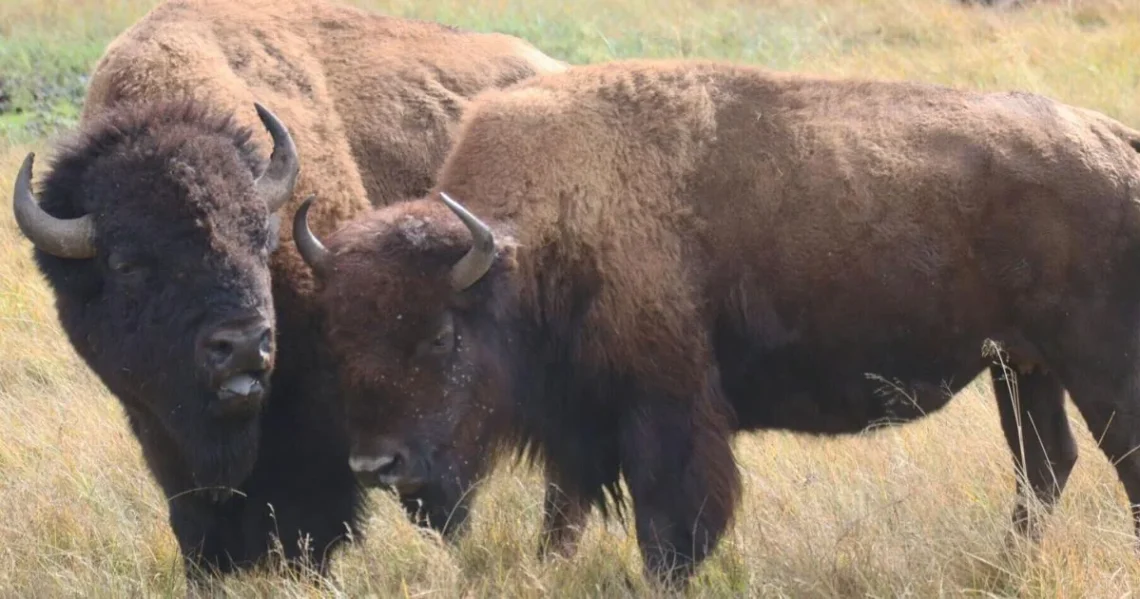
LIVINGSTON, MT — Old bison bones from Wyoming are helping rewrite what scientists know about one of North America’s most iconic animals. A new study used genomes from ancient and modern bison to show that herds once moved and mixed across enormous distances.
The research analyzed 160 bison genomes spanning the last 20,000 years and found that animals separated by thousands of miles were still closely related. That broad connection mattered before Europeans arrived, when bison ranged across much of the continent.
What The Bones Show
The Wyoming material came from five archaeological sites, plus 11 bison estimated at about 180 years old that were collected in the state’s Bighorn Basin by local community members. Those remains were part of a larger project that also drew on samples from Montana and other parts of North America.
The study looked not only at ancient animals, but also at 52 modern bison genomes to compare past and present patterns. Together, the samples showed that ancient herds were much more connected through gene flow than many living herds are today.
For researchers, the bones are more than isolated finds. They serve as a biological record that can be compared with modern animals, helping identify how bison changed as climate shifted, humans hunted them, and herds became fragmented.
How Researchers Studied Them
The paper, Paleogenomic insight into the collapse, recovery, and management of American bison, was published in Science. Lead author Jonas Oppenheimer of the University of California, Santa Cruz, worked with Montana and Wyoming scientists Craig Lee and Larry Todd, along with Parks Canada and other collaborators.
Lee contributed samples from ice-patch archaeology, a field that has produced animal and human remains from high mountain sites in places such as the Beartooth and Absaroka ranges. He said the ancient bones were especially useful for showing what the bison genome looked like before European cattle genes appeared.
Todd, a professor emeritus at Colorado State University and an adjunct professor at the University of Wyoming, said the study would not have been possible with the methods available a century ago. The combination of DNA analysis and accelerator mass spectrometry dating made the work possible.
From Expansion To Collapse
About 6,000 years ago, North America experienced warmer summers and colder winters, a shift that may have reduced grasslands and helped shrink bison numbers. Around the same time, wood bison emerged as a highly distinct species in Canada, though the precise timing and origin remain unclear.
The biggest rupture came after Europeans arrived. In less than 100 years, bison were driven to the edge of extinction, largely by market hunters killing them for hides, with support from the U.S. military. Disease and habitat loss pushed the population to fewer than 1,000 animals.
That collapse created a genetic bottleneck. The study found that cattle ancestry in modern bison is much lower than once believed, generally around 0.07 to 1.79 percent, and that some groups, including Yellowstone-origin bison and all wood bison, showed no evidence of cattle introgression.
Why It Matters Now
The study underscores how much can still be learned from museum and archaeological collections. Todd said long-preserved bison remains can support research questions that earlier scientists could not even imagine.
Lee said the findings also strengthen the case for conservation, because ancient genomes offer a baseline for understanding how bison once moved across North America. The researchers argue that reconnecting fragmented herds could help restore historical gene flow and improve resilience.
Today, the U.S. Fish and Wildlife Service estimates about 20,500 Plains bison in conservation herds and about 420,000 in commercial herds. For scientists, the old bones show that the species once lived as part of a much wider network than most modern herds do now.
More of America's buried past, on LSM Spartan Scroll.