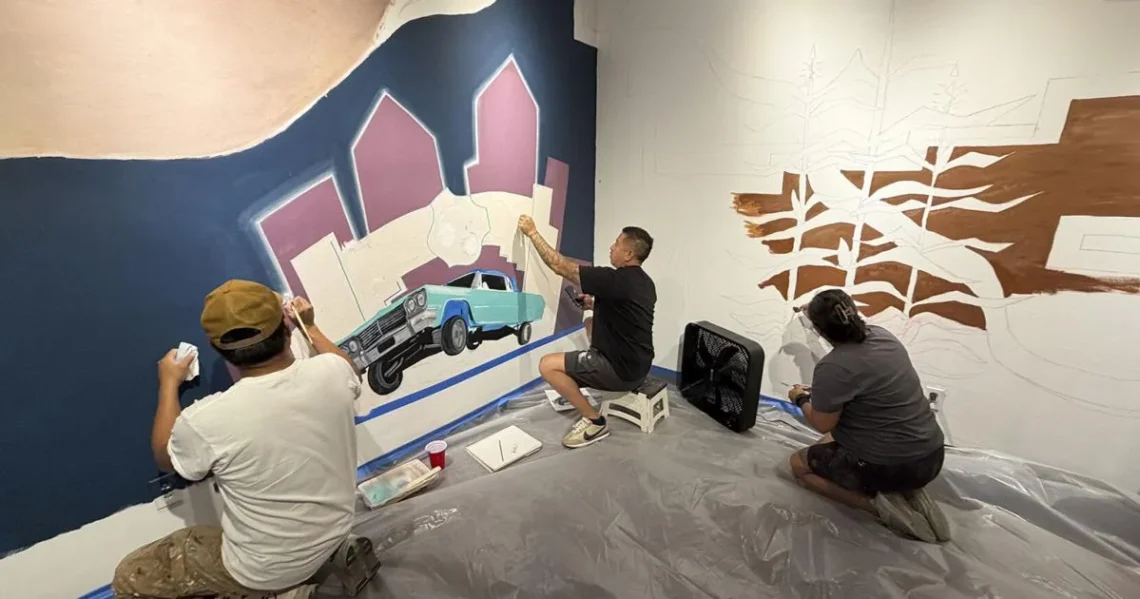
SANTA FE, NM — The Old Road is a new mural at the Indian Pueblo Cultural Center that looks at Route 66 through Pueblo experience instead of the familiar roadside nostalgia. The work is tied to the highway’s centennial celebrations in New Mexico and will be on view from August 1 through June 27, 2027.
Its subject is the long, uneven relationship between the Mother Road and Pueblo communities. The mural’s artists and digital collaborator use paint and augmented reality to show how the highway touched Indigenous lands, livelihoods, and sovereignty.
Where It Sits
The mural is installed inside the museum’s Art Through Struggle gallery at the Indian Pueblo Cultural Center. That setting matters, because the center sits only a few blocks from a section of Route 66 that existed before the road was realigned in 1937.
It is also about 1.6 miles from Central Avenue, the stretch that became Route 66’s longest urban run. In other words, the work is placed close to the historic roadway it is interpreting, not far from it or abstracted from its physical footprint.
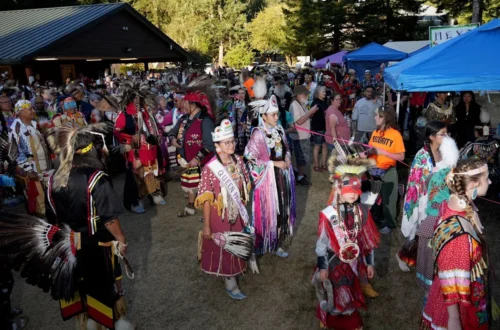
Route 66 crossed many Native nations over its length, and in New Mexico it ran through several pueblos. The mural uses that geography as part of its argument: the highway did not simply pass nearby, it cut across lived Indigenous space.
What The Evidence Shows
Much of what the mural presents comes from the artists’ reading of Route 66 history and the communities it reached. Curatorial assistant Eddie Vargas, who is Isleta Pueblo, pointed to the road’s route before and after the 1937 remapping as a key reference point.
The historical record cited by the project shows Route 66 crossing the Isleta, Sandia, Santa Ana, San Felipe, Cochiti, and Santo Domingo pueblos before the realignment. After 1937, it was remapped through Laguna and Acoma pueblos and the Navajo Nation.
The mural also reflects the lived memory of Native families. Vargas said his grandmother, who was from Isleta and Santo Domingo pueblos, sold handmade trinkets to travelers. That detail helps anchor the project in a broader pattern of roadside exchange and adaptation.
How The Road Changed
The mural’s artists treat Route 66 as both opportunity and disruption. For some Native people, it created income from travelers, but it also encouraged commercialization and cultural appropriation along the roadside.
Akilah Martinez, the extended-reality artist and developer who added the digital layer, connects the highway to earlier settlement patterns and to modern questions of sovereignty. She argues that roads built across Indigenous lands were created without permission and that tribal governments are now pushing back in new ways.
Martinez also links the highway system to older Indigenous trade networks. She says those routes were mapped through stars and celestial knowledge, and that if you layer ancient trade paths over today’s highways, they are nearly identical. Her contribution to the mural uses that idea to honor what came before Route 66.
What Visitors See Today
The 2D mural was designed and painted by Keith Scott, Margarita Paz-Pedro, and Warren Montoya. Scott said the work is organized by time rather than geography and includes Pueblo landmarks such as the water tower in Laguna Pueblo, along with different stages in the road’s development.
The painted piece spans three walls, and the team worked from scaled drawings to fit the space. Martinez then added an augmented-reality experience that visitors can access by scanning a QR code, which leads to a website with immersive material.
That digital layer is meant to make the wall art move beyond a static image. Together, the painted mural and the AR elements present Route 66 as a story of Pueblo presence, survival, and continuing questions about the land beneath the highway.
Why It Matters Now
The Old Road arrives during a year when many New Mexico institutions are marking Route 66’s 100th anniversary. But the mural pushes past celebration and asks who the road served, who bore its costs, and what it meant to travel over sovereign lands.
By combining historical detail, family memory, and digital art, the project places Pueblo communities at the center of a story that is often told as a national roadside legend. At the Indian Pueblo Cultural Center, that reframing is the point.
More of America's buried past, on LSM Spartan Scroll.