SILETZ, OR — The annual Nesika Illahee Pow-Wow in Siletz is a long-running celebration of Native culture built around dance, drumming, singing and food. This year’s gathering ran Aug. 7 to Aug. 9 at the Pauline Ricks Memorial Pow-wow Grounds.
The event drew thousands and centered on competition, community and ceremony. Its most striking finale is a free salmon feed, with fish cooked over an open fire and served to the public.
What Happens On The Grounds
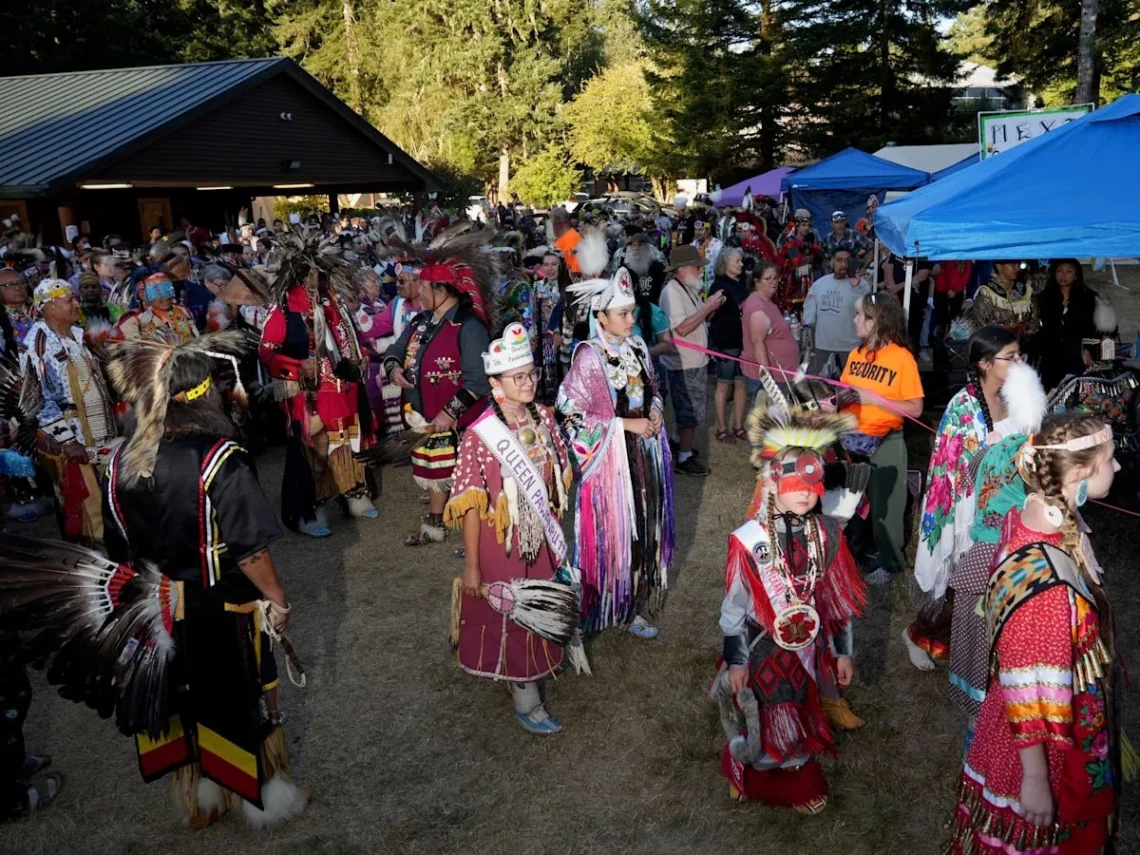
The powwow takes place on Government Hill in the small Oregon town northeast of Newport. Visitors watch dancers in the center ring while vendors line the grounds with jewelry, regalia and Native-themed goods.
Food is part of the experience as much as performance. Fry bread is sold throughout the grounds, and the public salmon feed gives the event a communal finish rather than a private one.
The tribe describes the gathering as a place for traditional dancing, drumming and singing from across Indigenous America and beyond. That mix of marketplace, performance and family reunion gives the grounds their festival-like feel.
How The Event Is Judged
Competition is the powwow’s central focus, and dancers are scored by judges. Their regalia, rhythm with the drum and ability to stop cleanly when a song ends all matter in the judging.
Different styles carry their own traditions. Fancy dancing is typically faster and uses eagle-feather crowns and backplates, while jingle dancing is for women wearing dresses fitted with metal cones that make sound as they move.
Drumming is just as important as footwork. Groups usually include six to 10 members, and some performers travel widely for powwows across the country.
A Tradition Brought Home
Selene Rilatos, a Siletz Tribal Council member, said the event was an adopted powwow brought to the reservation in the 1970s by her father and uncle. Since then, it has grown into a major annual homecoming for tribal families and friends.
James Williams, who has drummed since he was 7, said singers may use words in languages such as Lakota, Nakota, Cree and Navajo, while some songs have no words at all. For many participants, the music is tied to memory, identity and prayer.
Rilatos said dancing itself is spiritual, describing each step as part of a prayer. That sense of devotion helps explain why the event feels both competitive and deeply personal.
What Visitors Can See
The Nesika Illahee Pow-Wow is free and open to the public. It is held each year during the second weekend of summer, with the first grand entry on the second Friday of August at 7 p.m.
Activities continue late into Friday night, resume Saturday after a 10 a.m. parade through Siletz and a 1 p.m. grand entry, and finish Sunday at noon with another grand entry and the salmon feed at the Siletz Tribal Community Center.
Parking is free, and alcohol and drugs are strictly forbidden. For visitors, the event offers a close look at living tradition: dancers, drummers, food vendors and generations of families sharing one public space.
More of America's buried past, on LSM Spartan Scroll.