DENVER, CO — Colorado’s ghost towns are the leftover shells of mining communities, ranching stops and other frontier settlements that once tried to survive in the mountains and plains. The state has more than 1,000 of them by some counts, although fewer than half still show visible remains.
What makes them compelling is not just abandonment. In places such as Buckskin Joe and St. Elmo, the streets, stores and cabins still let visitors picture how people lived, worked and then left when the economy failed or the land changed.
What A Ghost Town Is
There is no official rule for when a place becomes a ghost town. Devin Flores of the Colorado Encyclopedia at History Colorado said the label is often more about shared feeling than a legal status.
Some places called ghost towns still have a few residents or businesses. Others sit on private land and are closed to visitors. In Colorado, many surviving sites are tied to mining, but some were emptied by flooding, health crises, pollution or larger economic collapse.
That variety is part of why the term sticks. A ghost town is less a single kind of place than a community that no longer functions as one, even if a few structures, or a few people, remain behind.
Buckskin Joe’s Long Afterlife
Buckskin Joe, officially named Laurette, began in the 1860s after Joseph Higginbottom, a mixed-race Canadian gold-panner and fur-trapper, found a gold vein in the mountains. Miners followed, and the town quickly filled out with homes, a saloon, a dance hall and a general store.
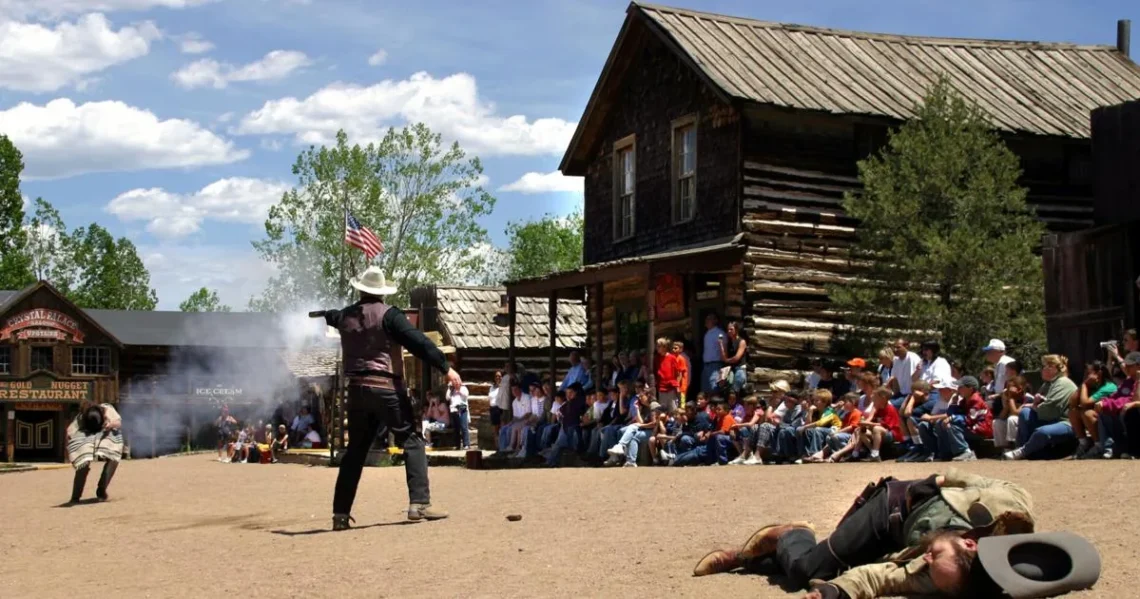
Its population reached 5,000 by 1861, but a smallpox outbreak and a thin gold vein sent people away. By 1866, the buildings were empty. Still, the town’s story did not end there. In the 1950s, an MGM Studios director moved old structures, including Horace Tabor’s general store, to a movie set near Cañon City. The set later became a Wild West theme park until 2010.
Why Historians Study Them
Researchers and local historians use these towns to trace how quickly western settlements rose and fell. Buckskin Joe shows how a mining camp could become a legend, then a movie set, then a tourist attraction. St. Elmo, by contrast, survived as a remarkably intact mining town with 40 original buildings.
Melanie Roth, a board member and historian with Historic St. Elmo, said the town has not been heavily altered, which makes it easier to imagine the street life of the 1900s. Other sites, including Dearfield, Gothic and Gilman, show that ghost towns do not all come from mining alone. Their histories reflect changing labor, resources, health concerns and environmental pressures.
What Visitors See Now
Some Colorado ghost towns remain accessible and partly interpreted for the public. At St. Elmo, a general store sells antiques, souvenirs, ice cream and snacks, while 40 old buildings still stand. Ashcroft offers a self-guided visit past a jail, stable and saloon. Vicksburg and Winfield include standing log buildings, an audio guide and a museum cabin.
Other places are harder to reach or are no longer open in the same way. Buckskin Joe’s buildings still exist on a private ranch, but they are hidden from public view. Visitors can also find places where only a few structures remain, such as Dearfield, or where a town’s ruins are now part of another landscape, as at Swallows and Gilman.
More of America's buried past, on LSM Spartan Scroll.