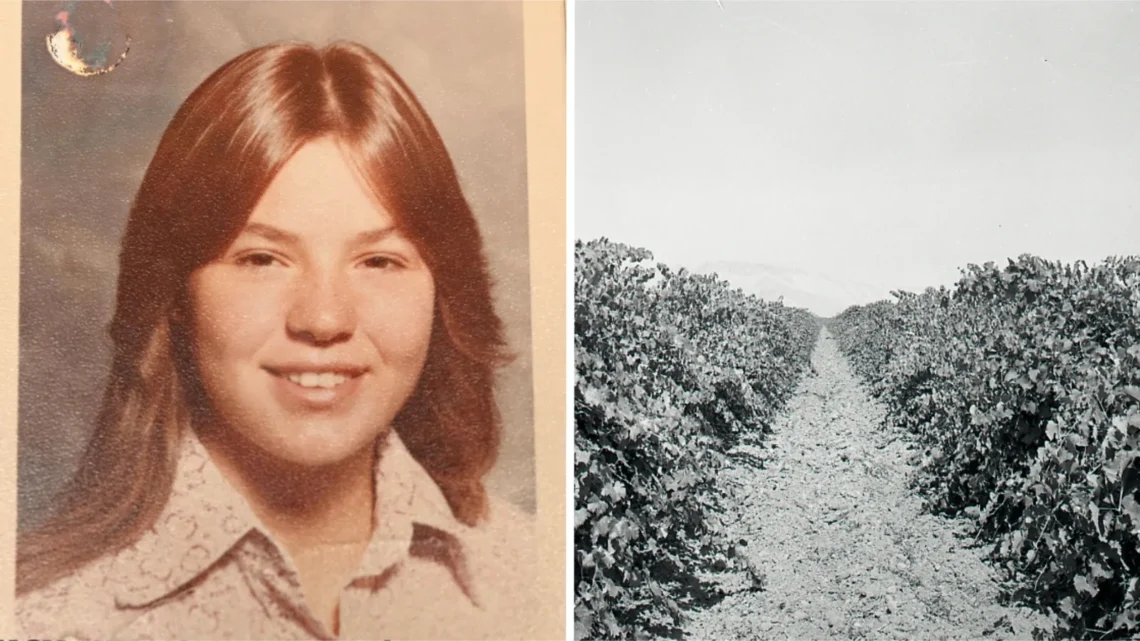
BAKERSFIELD, CA — For nearly half a century, a Jane Doe in a California murder case had no name. Now Kern County investigators say the victim has been identified as 15-year-old Michelle Louise Collier, a Fresno teen whose remains were found in June 1978.
The case had long been stuck with the limits of older forensic methods. Deputies said the remains could not be identified at the time through fingerprints or dental records, leaving the young victim listed as unknown for 48 years.
The Place And Remains
The remains were discovered in an Arvin vineyard, in Kern County’s agricultural country. That location has become the fixed point of the investigation, even as the woman’s identity remained out of reach for decades.
According to the sheriff’s office, the victim was a 15-year-old girl from Fresno. The identification gives the case a name and a hometown, but it does not close the homicide investigation itself. Officials said the case remains open, and the absence of a dedicated cold case unit in the department has not stopped the inquiry from continuing in some form.
What makes the site significant is not a visible landmark or ruin, but the way a roadside vineyard held an unanswered death for so long. The discovery there in 1978 set everything that followed in motion.
How The ID Emerged
Investigators said the breakthrough was built on a series of DNA steps that took years to unfold. In 2007, authorities learned that no DNA sample had been collected from the body when the remains were first handled, so the body was exhumed to obtain one.
That sample was sent to the California Department of Justice, but there was still no match because family DNA was not in the available databases. The case stayed stuck until a consumer DNA test taken by Collier’s family produced a match.
For detectives, the identification shows how a case can remain unsolved not because evidence is absent forever, but because the tools to read it were not yet available. The sheriff’s office said the identification finally reunited Michelle with her family and restored her name after decades as Jane Doe.
How The Case Went Cold
The original investigation dates to June 1978, when the unidentified girl’s remains were found. At the time, the available identification methods were narrow compared with what investigators can use now, and the case lost momentum once those methods produced no answer.
The lack of a DNA sample in the early years became a crucial gap. Once that problem was discovered decades later, exhumation offered a second chance, but only for a sample to work with. Even then, without a relative already represented in a database, the sample could not connect to a name.
The sheriff’s office said the case is still open. Anyone with information is being asked to contact Kern County authorities, a reminder that identification can solve one part of a homicide case while leaving the question of what happened in 1978 still unresolved.
What It Means Now
Today, the most important thing about this case is the return of a name to a person who had been lost in records for 48 years. That kind of identification changes the meaning of a cold case for a family, even when the criminal investigation continues.
For researchers and investigators, the case also shows how modern DNA testing can reach back into older mysteries that once seemed permanent. A consumer test, paired with preserved material from exhumation, provided the link that fingerprints and dental records could not.
There is no museum display here and no public monument to visit. What exists instead is an active homicide case, a restored identity, and a file that remains open in Kern County while detectives look for more answers.
More of America's buried past, on LSM Spartan Scroll.