
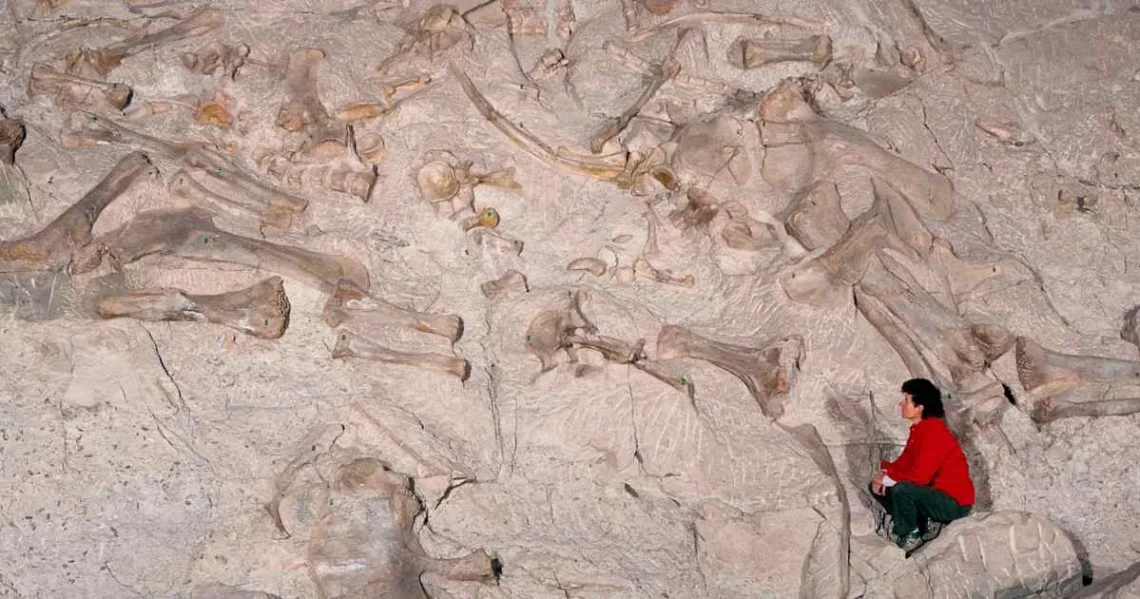
WASHINGTON, DC — Dinosaur fossils are reminders that the American landscape still holds traces from a world far older than humans. Dinosaurs lived on Earth for an estimated 165 million to 180 million years, while Homo sapiens have been around for about 300,000 years.
That gap is why fossil bones, footprints and other evidence can still appear in ordinary places. One of the most striking examples is a Pennsylvania bridge stone that carried a dinosaur footprint, a detail that made a 1930s structure in what is now Gettysburg National Military Park unexpectedly famous.
What Fossils Preserve
The thing being preserved is not just bone. Dinosaur fossils can include tracks, impressions and other physical traces that capture how animals moved and lived. Some fossils are the remains of long-buried skeletons, while others are only footprints or marks left in ancient mud that later hardened into stone.
The source also notes that fossil-looking finds are not always dinosaur remains. Large bones and tracks can belong to extinct Ice Age animals, including mammoths, whose time on Earth overlapped with humans. That distinction matters when visitors come across a fossil in a museum or in the field, because size alone does not tell the whole story.
How Scientists Know
What is known about these fossils comes from the work of researchers, museum collections and the places where the evidence survives in plain sight. In the Gettysburg case, the footprint was identified in a capstone built into the bridge, giving scientists and park interpreters a concrete object to study rather than just a story about a strange stone.
Fossils are also assessed by comparing shape, context and age. Footprints are read differently from bones, and both are separated from younger Ice Age material when possible. That careful sorting is what allows experts to say whether a discovery belongs to a dinosaur or to a later creature such as a mammoth.
A Stone's Journey
The Gettysburg footprint offers a vivid clue about how ancient evidence can travel. A stone formed long before the 1930s was cut and used in a bridge, then became notable when the footprint was recognized. In that sense, the fossil was not discovered in a remote dig site but embedded in everyday construction.
The source does not say exactly when the footprint formed, only that it existed before the bridge was built and that the capstone became part of the park landscape. In 2025, someone removed the capstone, and it had not yet returned to public display. That recent disappearance only sharpened interest in a stone that already connected modern visitors to prehistoric time.
What Visitors Can See
For today’s visitors, the appeal of dinosaur fossils in the United States is partly their rarity and partly their surprise. They can be found in museums, in track-bearing rocks and, sometimes, in places no one would expect, like a bridge stone in a military park. The fascination comes from seeing evidence that survived across millions of years and then survived again in a human-made setting.
The Gettysburg capstone is a reminder that fossils are not only remote scientific objects. They can become public artifacts, interpreted by parks and museums and valued for the way they link deep time to familiar places. Even when a fossil is temporarily out of view, the story behind it keeps drawing attention to the ancient world under American ground.
More of America's buried past, on LSM Spartan Scroll.