
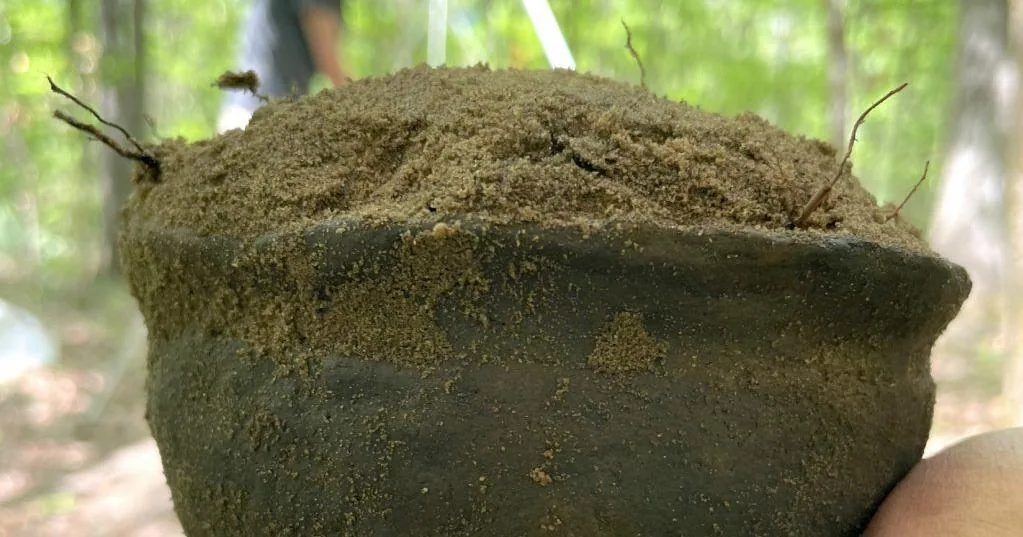
GAINESVILLE, FL — A small pottery vessel found at Mission San Francisco de Potano is giving archaeologists a fresh look at a 17th-century Spanish mission site in North Florida. The pot was discovered intact, which is unusual enough on its own.
The artifact likely dates to the years when the mission was operating, and it emerged from a site that has produced more than 7,000 artifacts since 2006. Most of those finds have been fragments, not whole objects, so this one stood out immediately.
What The Site Is
Mission San Francisco de Potano sits in a shady patch of woods northwest of Gainesville, where excavation units mark the remains of a kitchen, a friar’s residence and a nearby Potano village. The site is tied to the Potano, a Timucua group in North Florida, and to a Spanish mission established there in 1606.
Today, students and archaeologists work in 1-by-1 meter excavation squares, moving carefully through the soil in search of artifacts. The mission itself was abandoned in 1706, but its traces remained buried long enough to be found again generations later. The setting is modest, but the archaeological record is deep.
How Researchers Know
The findings come from a long-running field course led by Gifford Waters and Charles Cobb at the Florida Museum of Natural History. Waters, who studies historical archaeology collections, said whole pottery vessels are rare in his experience because most items are broken before or after burial. The intact pot therefore caught attention right away.
Since 2006, students and archaeologists have collected Native American pottery sherds, glass beads, stone tools, nails and animal bones from the site. They have also used artifact patterns to identify activity areas such as cooking spots and trash pits. In this case, the pot’s depth and location helped suggest it was made during the mission period, even if its style remains unfamiliar.
How It Was Used
The mission began when Spanish officials sent a friar to the Potano village in 1606, part of a wider effort to build more than 100 Catholic missions across Florida over the next century. The Potano had moved into the area in 1585 after Spanish forces pushed them from their earlier home. At the mission’s peak, only one European friar lived there among a village of a few hundred Potano people.
Later, records show that a small soldier garrison was added after British raids on missions intensified in the early 1700s. The pot was found inside a Spanish-made structure, which may have served as a barracks. Nearby military finds, including a gun rear sight and a musket side plate, make that theory plausible, though not yet certain. A second, larger vessel fragment suggests trade or migration also shaped daily life there.
Why It Matters Now
The pot’s meaning may never be fully pinned down. It lacks the charcoal residue archaeologists often expect on cooking vessels, so it may not have been set directly over a fire. Still, it may have held food, warmed portions or served some other purpose now lost to time. Its faint scorch marks could come from firing or from use near heat.
What makes the find valuable is context. Archaeologists say the distribution of bones, pottery and other debris tells them where people cooked, discarded trash and lived. The intact pot adds another piece to that story, and it does so at a site where Native traditions, Spanish presence and later military use all left layered evidence behind.
More of America's buried past, on LSM Spartan Scroll.