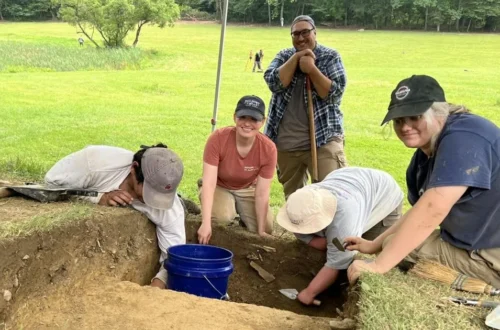
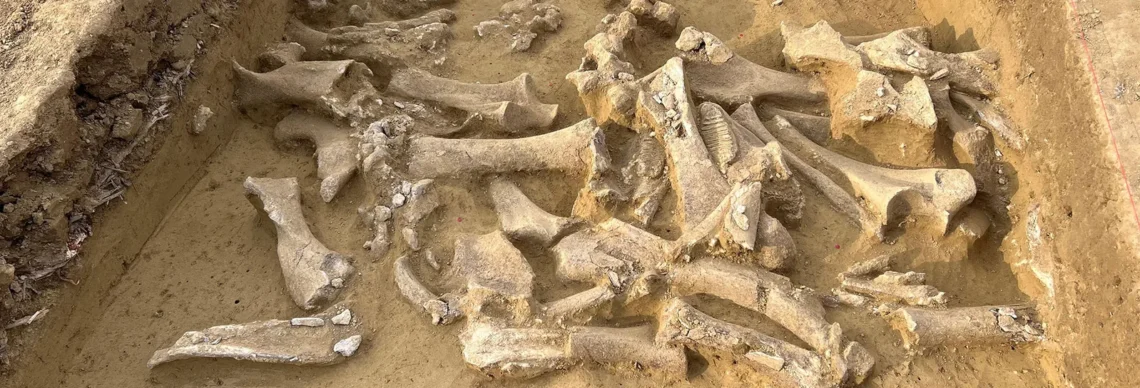
STOCKHOLM, DC — New DNA analysis of woolly mammoth bones suggests that Upper Paleolithic hunters in Eurasia and North America often selected female animals. The study drew on remains from more than 500 individual mammoths and compared bones from archaeological sites with those found in natural settings.
The work, released through Stockholm University and published in Current Biology, argues that the sex mix in the bone piles was unlikely to be accidental. Researchers say the pattern points to human hunting as the main force behind many of the accumulations.
What The Bones Show
The mammoth material came from two different kinds of settings. Bones found in natural places were mostly male, a pattern researchers link to solitary males dying in sinkholes or landslides that preserved their remains.
By contrast, about 70 percent of the mammoth bones from archaeological sites belonged to females. That difference is the heart of the study, because it suggests the sites were shaped by hunting choices rather than by random death in the landscape.
The result does not prove hunters only went after females. But it does show that female mammoths were overrepresented in the archaeological record, which is exactly the kind of skew scientists look for when trying to reconstruct ancient behavior.
How Researchers Tested It
The team used DNA analysis to determine sex across hundreds of mammoth remains. David Díez del Molino of Stockholm University said the comparison between natural and archaeological contexts made it possible to infer that human activity was the primary driver behind the bone accumulations.
That method matters because mammoth bones alone can be misleading. Without genetic sexing, a pile of tusks and fragments may look like a straightforward kill site when it could reflect a natural trap or some other process.
Hannah M. Moots of the University of Stockholm and Jarosław Wilczyński of the Polish Academy of Sciences both noted that the hunting behavior may have been more complicated than a simple preference for smaller animals.
Why Hunters May Have Chosen Females
One possibility is practical: female mammoths may have been easier to find because they lived in matriarchal herds with more predictable movements. That would have made them accessible targets for mobile Ice Age hunters.
Another possibility is risk. Wilczyński pointed out that if mammoths behaved like modern elephants, herds of females could have defended one another, making encounters dangerous even if the animals were easier to locate. The study leaves room for both ideas.
The researchers therefore frame the pattern as a clue to hunting strategy rather than a simple rule. The sex ratios imply purposeful selection, but they also show that ancient hunting was shaped by animal behavior as well as human choice.
What It Means Today
The study adds a new layer to how archaeologists interpret mammoth sites in the Ice Age world. It suggests that some bone accumulations preserve not just evidence of butchery, but evidence of choice, planning, and knowledge of herd behavior.
For readers and researchers, the key takeaway is that DNA can reveal what stone tools and broken bones alone cannot. The findings also show why mammoth remains from natural settings and archaeological sites have to be compared carefully before any conclusions are drawn.
The original research appeared in Current Biology, and Stockholm University’s statement summarized the study’s broader implications for understanding mammoth hunting across Eurasia and North America.
More of America's buried past, on LSM Spartan Scroll.