
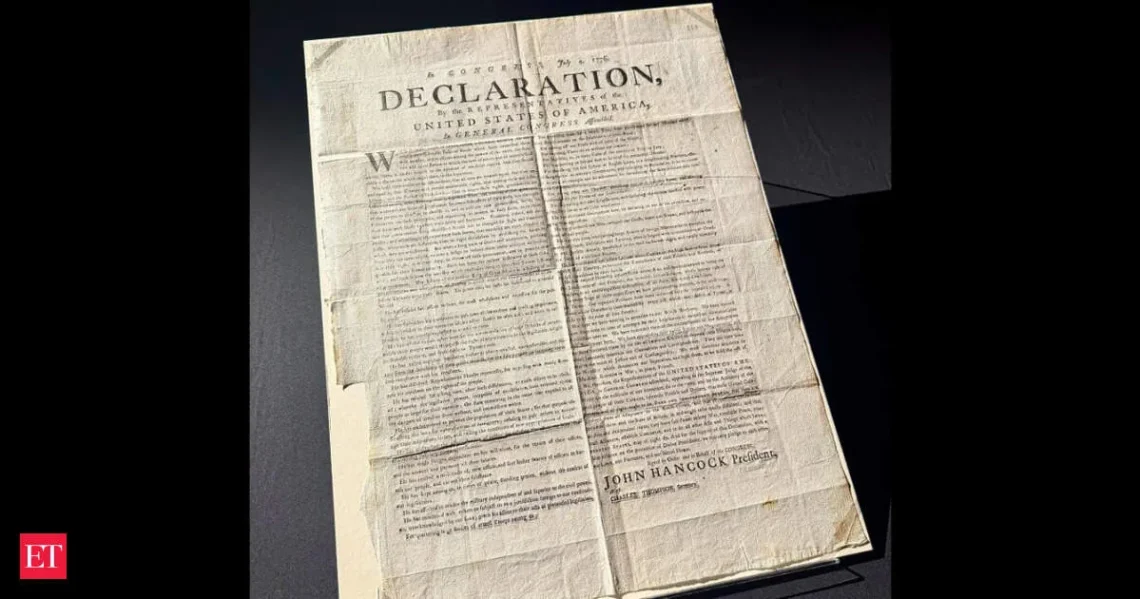
WASHINGTON, DC — A rare printed copy of the Declaration of Independence, created in July 1776, has been identified in Britain’s National Archives. Historians say it is one of only a handful of surviving examples from that particular printing.
The document matters because it shows how quickly news of America’s break from British rule spread beyond Philadelphia. Printed copies were the fast-moving version of the Declaration, carried to officials, soldiers, newspapers and local communities while the better-known handwritten engrossed copy was still just one formal version among many.
What The Document Is
The newly identified item is an early printed Declaration of Independence, not the handwritten copy displayed at the U.S. National Archives. It dates to July 1776, when printers were rushing to reproduce Congress’s words in a form that could travel quickly.
That was essential in the Revolutionary era. Printed sheets could be passed from hand to hand, posted, read aloud, or copied into newspapers. The source says surviving examples from that first printing are extremely scarce, which is why even one copy in an archive can change what scholars know about the document’s early circulation.
Its preservation in Britain is especially striking. The colonies had just declared independence from the very government whose archives would later hold this copy for nearly 250 years.
How It Was Verified
The document surfaced during an archival project at the National Archives in Kew, southwest London. A volunteer sorting through old records noticed a paper that did not look ordinary, even though it had been stored among government materials for generations.
Experts then examined the sheet closely. They compared typography, paper, layout and printing details with other known editions from the same period. That process confirmed it as an authentic early printing produced only days after Congress approved the Declaration.
The source does not describe a single dramatic discovery moment. Instead, it points to the slow, careful work of archival review, where familiar boxes can still contain items whose significance was missed for centuries.
How It Survived
British officials collected many kinds of material during the Revolutionary War, including intelligence, correspondence, newspapers, military reports and political papers tied to the conflict. Items that helped explain events in the colonies were often kept as part of government records rather than discarded.
Over time, the Declaration printing appears to have remained in those collections, perhaps because it was only briefly described or never fully cataloged in a way that revealed what it was. The result was a quiet survival inside a large archive, hidden in plain sight.
Its story also reflects how independence news moved across the Atlantic. Even as Britain and the colonies were breaking apart politically, officials on both sides were handling the same printed evidence of the rupture.
Why It Matters Now
For researchers, the copy is valuable not just because it is rare but because each surviving printing can show small differences in format, punctuation, typefaces, paper quality or later handling. Those details help historians reconstruct how revolutionary ideas circulated in 1776.
The find also underscores the importance of archives, volunteers and digitization work. Large collections still contain millions of manuscripts and printed items that have never been fully examined, and improved cataloging can reveal overlooked sources that reshape familiar stories.
For visitors and scholars today, the document is a tangible link to the moment America announced itself to the world. It shows that some of the most important evidence from the Revolution was not lost in battle or buried in the ground, but filed away and waiting to be recognized.