
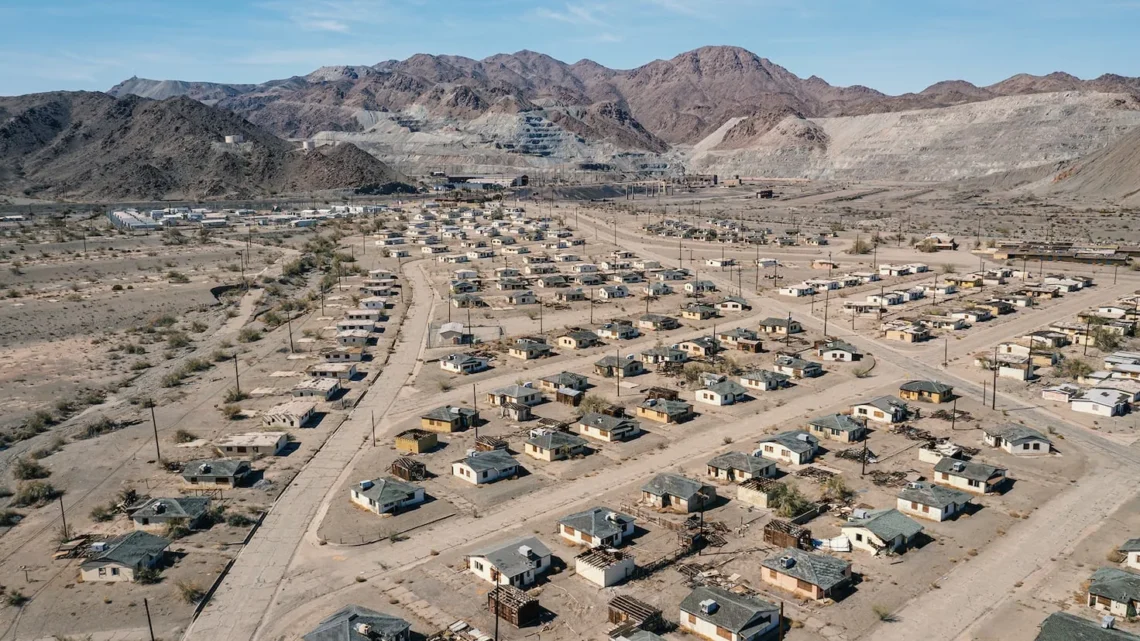
EAGLE MOUNTAIN, CA — Eagle Mountain was built in 1948 as a company town in California’s Mojave Desert, created by Kaiser Steel to house more than 4,000 iron miners and their families. It was meant to support the postwar growth of American steel, not become a relic.
Nearly 80 years later, the town is abandoned. Its empty streets and sealed buildings have made it one of the most striking ghost towns in the United States, a place where the scale of the project is still visible even after the people are gone.
What Eagle Mountain Was
Eagle Mountain was never a temporary camp. Kaiser Steel designed it as a self-contained desert community with more than 400 single-family homes, each with air conditioning. For the late 1940s, that was a remarkable level of comfort in the Mojave.
The town also had elementary and high schools, churches, community centers, recreational facilities, an Olympic-size swimming pool and a hospital. It was built to serve the mine and the families who depended on it, with everyday life organized around the needs of a major industrial operation.
The mine itself was huge. For more than 30 years, it operated around the clock, sending iron ore by private railroad to Kaiser Steel’s mill in Fontana, California, where the material helped supply steel for bridges, ships and skyscrapers across the American West.
How Historians Know
What is known about Eagle Mountain comes from the physical remains of the town, the industrial record of Kaiser Steel, and later reporting on the site’s abandonment and reuse. The surviving layout still shows how deliberately the town was planned.
The source account points to the mine’s long operating life, the railroad link to Fontana, and the later sale of the property in 2023. Those details help establish a timeline for how the company town grew, functioned and then slipped out of use.
Researchers and observers have also used Eagle Mountain as a case study in the life cycle of industrial communities. Its history is tied to the broader postwar boom, and its decline can be traced through the closure of the mine and the loss of the jobs that sustained the town.
Rise And Collapse
Eagle Mountain grew out of the economic optimism that followed World War II. Kaiser Steel needed a stable labor force for iron mining, and building a town from scratch was the company’s answer. The goal was efficiency, but the result was a community that looked almost utopian in the desert.
That promise did not last. By the late 1970s, international competition, tighter environmental rules and rising operating costs began to undermine the mine’s future. The mine shut down permanently in 1983, and residents left soon after.
A later attempt to give the site a second life as a low-security private prison only delayed the decline. After a fatal incident, the prison closed in 2003, and the town went quiet again.
What Remains Today
Today, Eagle Mountain stands closed to the public, with empty streets and aging infrastructure still in place. In April 2023, the entire abandoned town, including nearly 25 square miles of land and the mining rights, was sold to Ecology Mountain Holdings for $22.5 million.
The property has spent years caught in disputes over proposals for a massive landfill or a pumped-storage hydroelectric facility. That uncertainty is part of the site’s modern identity: not fully erased, but not yet reborn.
Its eerie landscape also drew filmmakers. Michael Bay used the location for The Island in 2005, and Christopher Nolan filmed part of Tenet there in 2020. For visitors and researchers alike, Eagle Mountain remains a rare, preserved trace of America’s industrial age and the company-town world that came with it.