
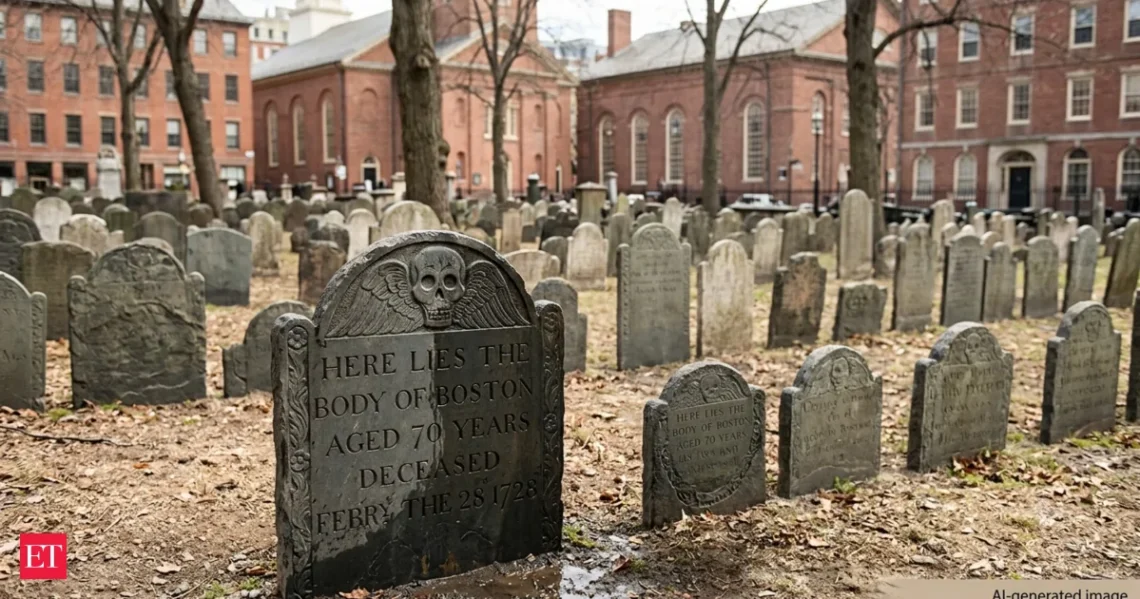
BOSTON, MA — The gravestone of Boston, a free Black man buried in 1729, was found again almost 300 years after his death. It sits in the Granary Burying Ground, one of the oldest cemeteries in the city, where more than 5,000 graves are said to remain.
The marker is notable not only because it survived so long, but because it preserves a rare colonial-era record of a Black man who had once been enslaved and later lived as a free person. The stone gives his age as 70 and, under the old Julian calendar used in the colonies, records his death as February 28, 1728, which is 1729 by modern dating.
What The Stone Is
Boston’s stone is a modest tombstone, but it carries more than a name. It identifies him as Boston, gives his age, and includes a carved death’s head, the winged skull image that was common on New England gravestones in the late 1600s and early 1700s.
The marker was recovered during a restoration project at the Granary Burying Ground. That cemetery was established in 1660 and remains one of the city’s most important historic burial places. The stone stands out because it belongs to a man whose life moved from slavery into freedom, leaving behind a rare physical trace in a period when such records were often thin or lost.
How Researchers Identified Him
The rediscovery began when Kelly Thomas, director of the Historic Burying Grounds Initiative for the Boston Parks and Recreation Department, noticed a headstone with only one name while reviewing cemetery photographs. That small clue prompted a deeper search in historical records.
Researchers linked the stone to a man known at different times as Boston, Sebastian, and Bastian. Records show that Boston and his wife, Jane Lake, had a daughter named Jane, baptized at Boston’s First Church in 1701. The family had been enslaved in different households, which helped explain why their records appear scattered rather than neatly preserved.
By 1708, Boston appears on a list of free Black people, suggesting he had already gained freedom by then. He had also developed a reputation as a hardworking handyman, a detail that helps fill in a life otherwise known mainly through scattered documents and the gravestone itself.
From Enslavement To Freedom
Boston was likely freed sometime after the 1702 death of John Waite, the man who had enslaved him. The exact moment of manumission is not known, but the paper trail suggests a change in status sometime in the early 18th century.
His burial record adds another unusual layer. When he died, an obituary appeared in the New-England Weekly Journal, a rare notice for a Black man in colonial America, whether enslaved or free. That published remembrance, along with the gravestone, shows that Boston was known enough in his community that his death was recorded in more than one way.
The date on the stone also reflects the calendar shift that later caused confusion. Colonists used the Julian calendar until 1752, so the February 28, 1728 date on the marker corresponds to February 28, 1729 in the modern calendar.
Why It Matters Now
The stone matters because it gives historians something unusually direct: a named memorial to a free Black man from the colonial period, preserved in plain sight in a major historic cemetery. Boston’s mayor, Michelle Wu, said the discovery was likely one of the oldest gravestones of a free Black person in America.
For visitors, the marker is a reminder that the Granary Burying Ground is not just a place of famous names but also of lives that were nearly erased from memory. For researchers, it offers a concrete starting point for tracing Boston’s identity, family, freedom, and place in early Boston history.
The headstone had been there all along. What changed was the attention given to it, and the historical work that turned a single name back into a story.
More of America's buried past, on LSM Spartan Scroll.