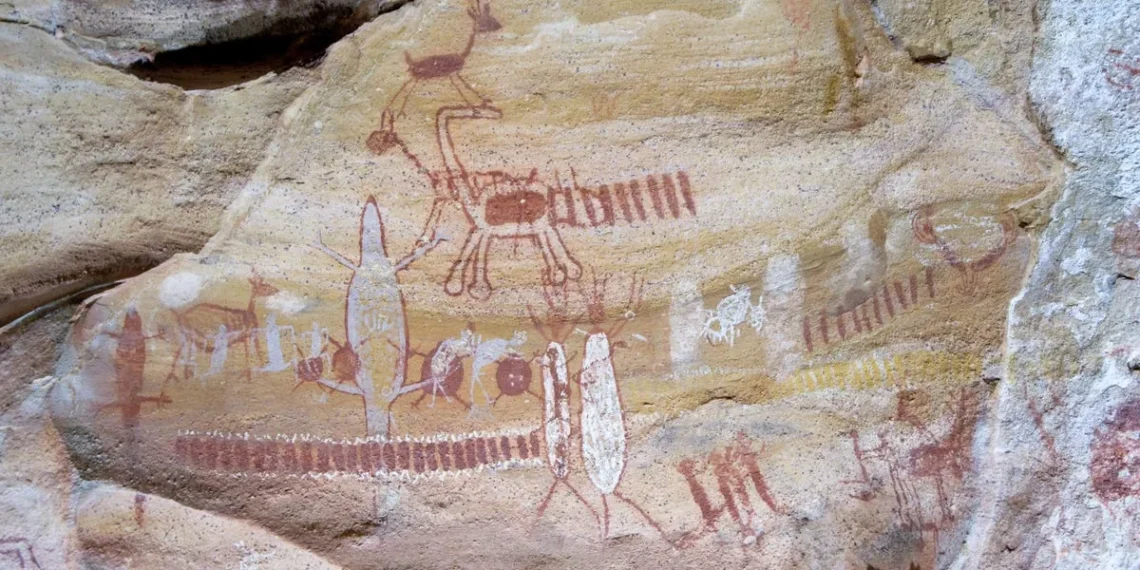
WASHINGTON, DC — The Santa Elina rock shelter in Mato Grosso, central Brazil, has become one of the most debated places in the story of the Americas’ first people. Researchers say a layer there dating to roughly 25,000 to 27,000 years ago held giant sloth bones that humans may have altered on purpose.
The most striking claim is simple and explosive: three osteoderms from the giant ground sloth Glossotherium phoenesis appear to have been drilled, smoothed, and worn as pendants. If that reading holds, the site would push back the earliest known human presence in South America by about 12,000 years.
What Santa Elina Is
Santa Elina is a rock shelter, not a village or a burial ground, and the evidence comes from a deep archaeological deposit rather than a single dramatic object. The bones in question are osteoderms, the bony plates embedded in the skin of a giant ground sloth.
Researchers also report stone artifacts in the same layer. That association matters because the claim is not only that the sloth remains were present, but that people were working with them in the shelter itself, in a layer they date to the late Ice Age.
The significance grows because the older layer sits far earlier than the continent’s long-accepted benchmark sites. On the published timeline, Santa Elina would stand well ahead of the date generally assigned to early South American occupation.
How Scientists Studied It
The case for human modification rests on close inspection rather than guesswork. The team used advanced microscopy and optical scanning to examine the holes, looking for tool marks, scraping, polishing, and wear that would match deliberate drilling and later use.
They argued that the perforations preserve stone-tool striations and that the surfaces are smoothed in a way consistent with the pieces being strung and worn. The researchers also compared the marks with bite damage and other natural processes before concluding that rodents and digestive activity do not explain them.
Mirian Pacheco, one of the study authors and a paleontologist at the Federal University of São Carlos, said the objects’ exact meaning cannot be recovered, but the physical evidence points toward pendants. Thaís Pansani later expanded the site work with radiocarbon dating and isotopic analysis in 2024.
How The Debate Grew
The Santa Elina claim is controversial because very early sites often sit in deposits shaped by fire, frost, rockfall, and water, any of which can imitate human action. Critics note that the site’s chronology is based on sediment, wood, and bone, not on the act of tool-making itself.
Archaeologist André Costopoulos pointed out that only three of 7,069 recovered osteoderms were judged human-modified, and he cited research showing that insect and microbial damage can resemble the Santa Elina holes. The broader question, then, is whether the marks are cultural or natural.
The argument has continental consequences. If Santa Elina is right, it would sit roughly 12,000 years earlier than Monte Verde II in Chile, long treated as the key early site in South America. Ancient DNA studies still point to first entry around 16,000 to 23,000 years ago.
What It Means Now
Today, Santa Elina is less a settled answer than a test case for how archaeologists decide what counts as proof. Researchers say the shelter’s layers deserve continued scrutiny because the site may preserve evidence of very early human activity in South America, even if the final interpretation remains unsettled.
For visitors and researchers, the appeal is not a display case of finished answers but a landscape of hard questions. The shelter stands as a reminder that ancient bone can hold competing stories, and that the line between human craftsmanship and natural alteration is often the hardest problem in early American archaeology.
The site also keeps drawing attention because new work has not closed the debate. In that sense, Santa Elina is important not only for what it may prove, but for how sharply it shows the limits of current evidence.
More of America's buried past, on LSM Spartan Scroll.