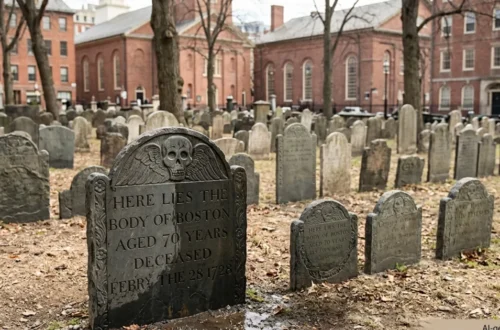
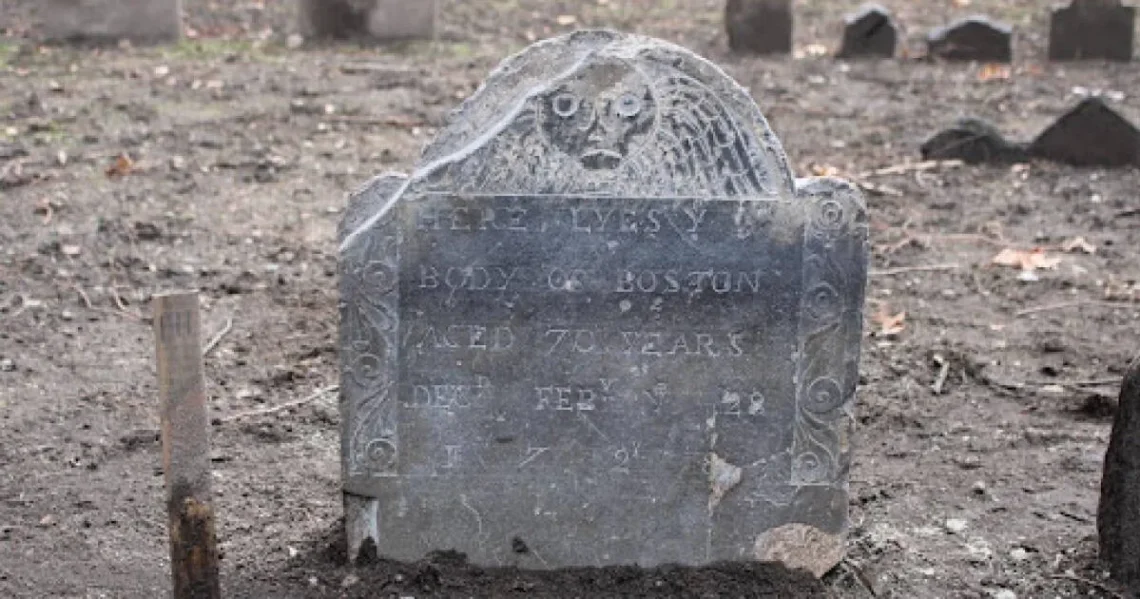
BOSTON, MA — City preservationists in Boston have rediscovered the gravestone of a free Black man who died nearly three centuries ago. The marker, dated 1728, was found in Granary Burial Ground near Park Street and may be one of the oldest gravestones for a free Black person in the United States.
The stone belonged to a man known in the records as Boston, and researchers later linked it to Sebastian, a formerly enslaved man whose life appears in colonial documents. The find is notable not only for its age, but also for the unusually rich paper trail attached to it.
What The Stone Is
The gravestone is a weathered colonial marker that had been partly buried and badly damaged before it was restored. It sits in Granary Burial Ground, one of Boston’s best-known historic cemeteries, where the city’s Historic Burying Ground Initiative has been surveying old monuments.
Kelly Thomas, who directs Boston’s historic burying grounds, said the stone carried only the name “Boston” and no surname. In colonial burial records, that kind of single-name marker often points to a person who had once been enslaved. The location matters, too, because the burial ground helps show how Boston’s early population included free and enslaved Black residents.
How Researchers Identified It
Thomas said she first noticed the gravestone in February during a survey of about 100 markers in the Granary grounds. The stone had not appeared in an earlier survey, which is part of why it escaped notice for so long.
She then searched Boston colonial records and found a web of references that connected the marker to a man whose name seems to have shifted over time from Sebastian to Bastian and eventually to Boston. She also found an obituary in a 1729 Boston newspaper, a rare source for any person from that era, which described him as respected, honest, and well regarded by neighbors.
Sebastian’s Life And Death
The man behind the stone appears to have been born into bondage and later won his freedom. According to historian Gloria McCahon Whiting, he worked for years to gain permission to legally marry his wife, who was also enslaved, and he built alliances with white residents along the way.
Whiting said his efforts may have influenced the publication of New England’s earliest antislavery tract and Massachusetts legislation supporting marriage rights for enslaved people. He later fathered six children, baptized them in a local church, and supported them economically. When he died at age 70, his funeral was said to have drawn uncommon respect.
Why The Marker Matters
The rediscovered gravestone broadens what historians know about burial practices in colonial Boston and about the city’s multiracial past. Officials say it underscores how historic preservation can recover stories that were long overlooked, even in a place studied as often as Boston.
Today, the marker remains a physical link to a man whose life crossed slavery, freedom, family, and community standing. For visitors and researchers, it is also a rare surviving stone that helps explain how people of African descent lived and were remembered in early America. That combination of age, documentation, and survival makes the gravestone unusually significant.
More of America's buried past, on LSM Spartan Scroll.